Understanding Aquaponics: The Basics
Aquaponics is a food production system that combines aquaculture (raising fish) with hydroponics (growing plants in water without soil). In this symbiotic environment, fish provide nutrients for plants through their waste, while plants purify the water for the fish.
The concept isn't new—ancient civilizations including the Aztecs practiced a form of aquaponics using floating gardens called chinampas, a history Cornell's home-hydroponics guide also opens with. Modern aquaponics has refined these principles using contemporary technology.
How Does Aquaponics Work?
The aquaponics cycle involves three main organisms working together:
- Fish — produce waste (ammonia) as a byproduct of their metabolism
- Beneficial bacteria — convert ammonia into nitrites, then nitrates (plant food)
- Plants — absorb nitrates as fertilizer, filtering and cleaning the water
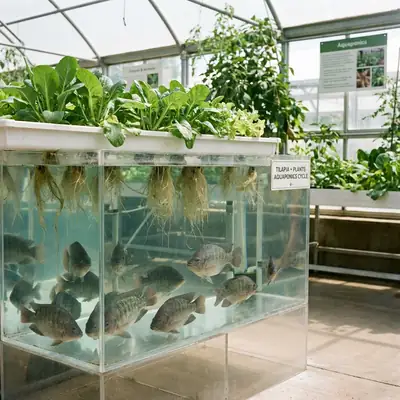
The FAO's technical report on aquaponics describes the system the same way: it combines the two most efficient methods in their respective fields — recirculating aquaculture systems (RAS) and hydroponics — so that nutrient-rich aquaculture water is recirculated through hydroponic growing beds. The fish waste supplies all of the plants' nutrients, removing the need for added fertiliser, and the plants clean the water for the fish, removing the need for regular water exchanges.
Benefits of Aquaponics
Water Conservation
The same water circulates through the system again and again — fish tank, grow bed, back to the tank — so nothing drains away or runs off the way it does in a soil garden. The FAO puts a number on it: in its 2019 technical report on Caribbean aquaponics it states that aquaponics can use up to 90 percent less water than traditional irrigation systems, which is why the FAO calls it an ideal system for regions with scarce freshwater and limited land.
No Soil Required
Since plants grow in water, you can set up an aquaponics system anywhere—indoors, on rooftops, in urban areas, or in regions with poor soil quality.
Fewer Inputs
Because the fish waste feeds the plants, New Mexico State University's aquaponics guide notes that a combined recirculating system needs no chemical fertilizers and no routine discharge of water or filtrate. The same guide explains why pesticide sprays are largely off the table too: aquaponic systems normally operate without pesticides because a spray that kills the bug will very likely kill the fish — the produce comes out pesticide-free as a side effect of keeping the fish alive.
Compare that with plain fish farming: in a traditional aquaculture system, ammonia from animal waste builds up to toxic levels, so 10 to 20 percent of the water has to be discharged and replaced every day (NMSU Guide H-170). In aquaponics that waste water instead flows to the plants, which strip out the nutrients before the water returns to the fish.
Less Work Than Soil Farming
The FAO's 2019 report describes aquaponics as a labour-saving technique: it removes the traditional field work of ploughing, tilling and digging, which the report says makes it suitable for all genders and many age groups. Because the beds are containers of water and inert media, the report also notes systems can be located inside the home — an option it links to household income and food security rather than to farm acreage.
Growth Rate
Be careful with the "grows twice as fast" claims you will see online — few can be traced to a study. What is verifiable is the mechanism the FAO describes: the plants' nutrients come from the fish waste, delivered through water that keeps circulating, so the roots never have to search soil for food or water. Expect a slow start in a brand-new system while the fish, bacteria and nutrient reserves establish themselves — sluggish growth in the first weeks is normal, not a sign of failure.
Types of Aquaponics Systems
NMSU Guide H-170 describes three primary ways to grow the plants, whatever the size of the system. Whichever you pick, every aquaponic system shares the same five components: a rearing tank for the fish, a settling basin to capture uneaten feed and waste, a biofilter where bacteria convert ammonia to nitrates, the hydroponic portion where the plants grow, and a sump — the lowest point where water collects before being pumped back to the fish.
1. Media-Based (Flood and Drain)
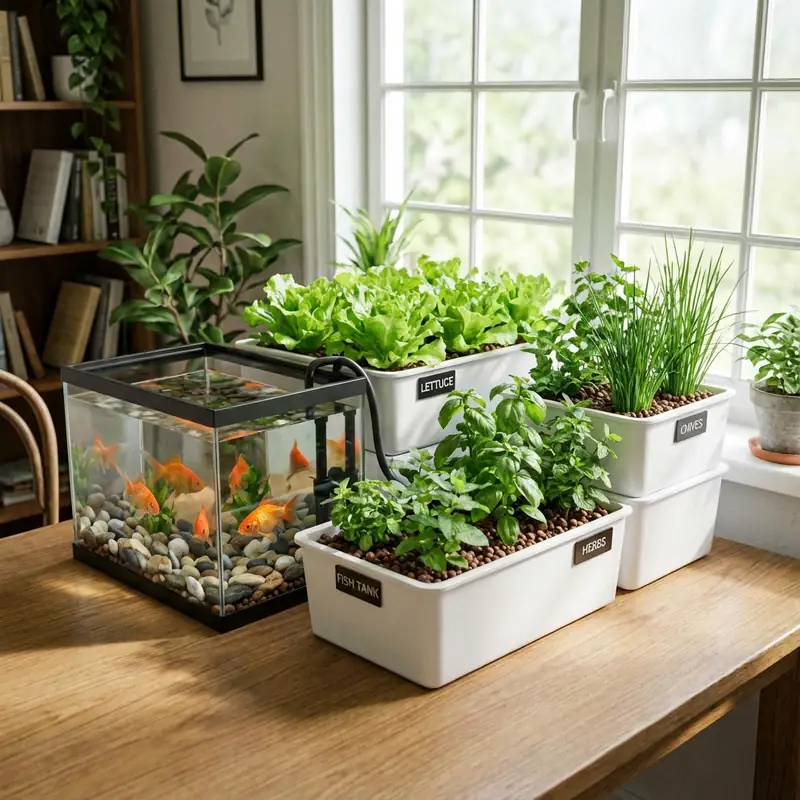
Plants grow in inert media — gravel, rock wool, sand or clay pellets, in NMSU's list — held in a container that is periodically flooded with water from the fish side and drains back. The media does double duty: it holds the plants and gives the nitrifying bacteria a large surface to live on.
2. Raft-Based / Deep Water Culture (DWC)
Plants sit in holes in floating rafts (H-170 describes Styrofoam rafts) with their roots hanging directly into troughs of filtered fish water. "Filtered" matters: the solids are removed before the water reaches the raft troughs, so the roots hang in clear-ish nutrient water rather than in waste.
3. Nutrient Film Technique (NFT)
Plants sit in the tops of shallow channels while filtered water trickles along the root zone as a thin film. One warning from the sources: NFT channels do not offer enough surface area for the nitrifying bacteria, so H-170 says an NFT system requires a separate biofilter. In media and raft systems a separate biofilter is sometimes not needed at all, because the media, rafts and tank walls provide enough surface — though NMSU Circular 680 notes most of those systems still use some kind of biofilter to help break down organic matter.
Getting Started
Ready to dive in? Match the list to the five components above:
- Fish tank — any food-safe container sized to the fish you plan to keep
- Grow bed or trough — plus growing media if you choose a media-based system (gravel, rock wool, sand or clay pellets)
- Water pump and air pump — the sump sends water back to the fish, and aeration covers the days when oxygen runs low
- Solids removal — something to catch uneaten feed and waste before the water reaches the plants or the biofilter
- Test kit — to monitor water quality. NMSU Circular 680 says aquarium test kits are adequate for most backyard systems; if your readings shoot past the top of the kit's range, dilute the test sample and multiply back.
Then the part nobody can skip: the system has to be cycled — the bacterial colony built up — before fish can live in it safely. Circular 680 treats a system as cycled once nitrate shows up and both ammonia and nitrite have fallen to 0.5 ppm or lower, a process that takes weeks, not days.
For a complete walkthrough, see our How to Build a DIY Aquaponics System guide, and for what to plant once the water tests clean, What to Plant in Aquaponics.